Senyuman Dah Cantik, Jangan Lupa Retainer!
Nov 20, 2026

November 20 2026
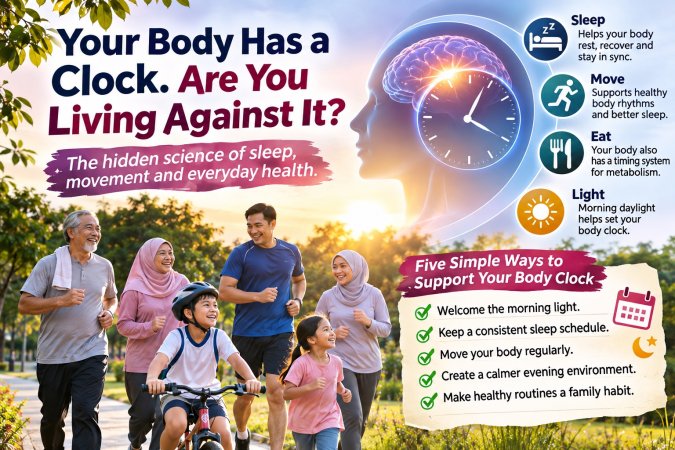
YOUR BODY HAS A CLOCK. ARE YOU LIVING AGAINST IT?
The hidden science of sleep, movement and everyday health
By Associate Professor Dr. Hazwani Ahmad Yusof¹ and Bdn. Elvi Suryani, SST., M.Kes.²
Have you ever wondered why you feel sleepy at almost the same time every night, or why waking up early after a late night can feel so difficult?
The answer lies in an extraordinary timekeeping system inside your body — your biological clock.
Most of us organise our lives around clocks, calendars and daily schedules. We set alarms to wake up, rush to work, plan our meals and try to find time for exercise. Yet, inside our bodies, another clock is quietly working around the clock. This internal timing system helps regulate when we feel awake, when we become sleepy, how our body temperature changes and how various hormones are released. Scientists call this approximately 24-hour cycle the circadian rhythm. Understanding this biological clock can help us make better decisions about sleep, physical activity and everyday health.
Your Brain Has Its Own Timekeeper
Deep inside the brain is a tiny group of nerve cells known as the suprachiasmatic nucleus, or SCN. Think of it as the body’s main timekeeper. It receives information about light from our eyes and helps coordinate daily rhythms throughout the body. When morning light reaches our eyes, it signals that a new day has begun. This helps our body become more alert and supports the timing of our sleep–wake cycle. As evening approaches and the environment becomes darker, the body normally begins preparing for sleep. One hormone involved in this process is melatonin, which helps signal biological night.
However, our modern lifestyle can sometimes interfere with these natural signals. Bright indoor lighting, late-night screen use, irregular sleep schedules and shift work can make it harder for the body to maintain a consistent rhythm. This does not mean that looking at a phone for a few minutes will automatically damage our health. Rather, the timing, brightness and duration of light exposure, together with our overall sleep habits, can influence how easily we fall asleep.
Does Your Body Know When You Eat?
Here is another fascinating fact: the brain is not the only part of the body with a biological clock. Many organs, including the liver, pancreas and muscles, have their own timing systems. These internal clocks help coordinate daily changes in metabolism, including how the body processes nutrients and uses energy. For example, our ability to handle glucose can vary across the day, partly because of circadian regulation.
Researchers are increasingly interested in how meal timing, sleep patterns and daily routines interact with metabolic health. However, this does not mean everyone should follow the same eating schedule or that eating after a particular hour automatically causes weight gain. What matters is the overall pattern of healthy eating, adequate sleep and regular daily routines. For families, a useful starting point is to avoid frequently skipping sleep to accommodate late-night meals or activities and to establish meal routines that fit their needs.
Can Exercise Help Your Body Clock?
We often think about exercise in terms of calories burned, muscles strengthened or heart health. But physical activity may also influence our biological rhythms. Research suggests that exercise can act as a timing cue for certain physiological processes, although its effects depend on factors such as the type, intensity and timing of activity. Regular physical activity is also associated with better sleep quality and overall well-being.
A morning walk, an afternoon cycling session or an evening exercise class can all contribute to a healthy lifestyle. There is no single exercise time that is best for everyone. Some people enjoy exercising early in the morning, while others find it easier to remain active after work. The most important factor is choosing a suitable time that allows physical activity to become a consistent habit without regularly interfering with sleep. For people who notice that vigorous exercise close to bedtime makes it difficult to fall asleep, moving the session earlier may be helpful.
Why Modern Life Can Confuse Our Internal Clock?
Consider a typical working day. We wake up early, spend much of the day indoors, sit in front of computer screens and return home feeling tired. At night, we may continue checking messages, watching videos or completing unfinished work. By the time we go to bed, our minds may still be active. The next morning, the alarm rings, and the cycle begins again.
When sleep schedules repeatedly shift, our internal timing system may struggle to remain aligned with our daily activities. This is particularly relevant to shift workers, healthcare professionals, students and individuals with irregular working hours. Circadian disruption has been associated with several health concerns, although the effects vary depending on the degree and duration of disruption and other lifestyle factors. For most people, improving daily routines can be a practical first step towards better sleep and well-being.
Five Simple Ways to Support Your Body Clock.
The encouraging news is that supporting a healthy biological rhythm does not require expensive devices or complicated routines.
1. Welcome the morning light. Spend some time outdoors in natural daylight after waking, when practical. Daylight helps signal to the brain that it is daytime.
2. Keep a consistent sleep schedule. Try to go to bed and wake up at approximately the same times each day, including weekends.
3. Move your body regularly. Walking, cycling, gardening or other enjoyable physical activities can support health and sleep.
4. Create a calmer evening environment. Reduce unnecessarily bright lighting and stimulating screen activities close to bedtime, particularly if they delay sleep.
5. Make healthy routines a family habit. Encourage regular sleep, shared physical activities and meal routines that are realistic for everyone in the household.
Adults generally need around seven to nine hours of sleep per night, although individual needs vary. People experiencing persistent insomnia, excessive daytime sleepiness or symptoms suggestive of a sleep disorder should seek professional assessment rather than relying only on lifestyle changes.
Two Countries, One Shared Health Message
Across Malaysia and Indonesia, modern lifestyles have changed how many people work, rest, eat and spend their free time. Although daily routines differ between individuals and communities, the basic biology of our internal clocks is shared. From an exercise science perspective, understanding circadian rhythms helps explain why physical activity, recovery and sleep are interconnected. From a public health perspective, the challenge is making this knowledge useful in everyday life.
Health education should not simply tell people to sleep earlier or exercise more. It should help individuals and families recognise the factors influencing their routines and identify realistic opportunities for improvement. A healthcare worker on rotating shifts, a parent caring for a young child and a university student preparing for examinations may all face different challenges. Therefore, healthy routines should be flexible, practical and adapted to individual circumstances. By combining scientific knowledge with family and community health education, we can help make the science of sleep and biological rhythms more understandable and relevant to daily life. Sometimes, Better Health Begins With Better Timing.
Our bodies are remarkable timekeepers. Even when we are not watching the clock, our brains and organs are coordinating countless biological activities throughout the day and night. We cannot always control our work schedules or daily responsibilities. But we can become more aware of how light exposure, sleep, physical activity and regular routines influence our well-being. Small changes, practised consistently, can help support healthier daily rhythms. The next time you feel sleepy at night or refreshed after a morning walk, remember that your body is responding to a complex timing system developed through millions of years of evolution.
Good health is not only about what we eat or how much we exercise. Sometimes, it is also about when we sleep, move and live.
About the Authors
¹ Associate Professor Dr. Hazwani Ahmad Yusof
Tun Abdullah Ahmad Badawi Cancer Centre (PKTAAB), Advanced Medical and Dental Institute (AMDI), Universiti Sains Malaysia, Malaysia.
² Bdn. Elvi Suryani, SST., M.Kes.
STIKes Darmais Padangsidimpuan, Indonesia.
Nov 20, 2026