A SCAN That Could Catch Lung Cancer Early, Even In People WHO Have Never Smoked
Nov 18, 2026

November 18 2026
Many people think lung cancer is only a smokers' disease. It is not. In Malaysia, a growing number of patients have never smoked, and most are diagnosed when the cancer is already advanced. A simple low-dose CT scan can help find it earlier, when treatment works best.
Lung cancer is found too late
Lung cancer is the second most common cancer in Malaysian men and the third in women [1]. Our national cancer registry shows that about 95% of patients with a recorded stage are diagnosed at the advanced stages (III or IV), and only about one in nine is alive five years later [1,2]. Early lung cancer usually causes no symptoms, so by the time a cough, breathlessness or weight loss appears, the disease is often far along.
What is a low-dose CT scan?
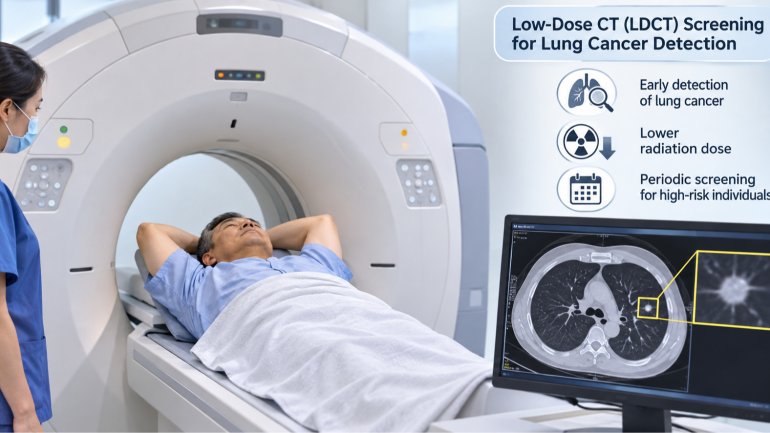
A low-dose CT (LDCT) scan takes detailed pictures of the lungs in just a few minutes. It needs no injection and uses much less radiation than a standard CT scan. Large trials found that screening heavy smokers with LDCT reduced deaths from lung cancer, by about 20% in the American trial and by about a quarter in men in the European trial [3,4]. In 2026, the World Health Organization's cancer agency (IARC) reviewed the evidence and concluded that LDCT screening of high-risk people lowers lung cancer deaths and reduces the number of cancers found late [5,6]. A chest X-ray can miss small early cancers and cannot replace an LDCT scan [3,7].
It is not only a smokers' disease
Smoking is still the biggest cause, and smokers should keep trying to quit. But lung cancer in people who have never smoked is rising worldwide, especially among women and younger adults [8]. In one Malaysian hospital study, about six in ten women with lung cancer were never-smokers [9].
Other risks include [7,10]:
Who should consider screening?
Malaysian expert guidelines published in 2025 recommend screening for [7]:
For other non-smokers, research is still under way. Taiwan's experience, described below, offers useful lessons.
What Taiwan's TALENT study found
In Taiwan, most lung cancers occur in people who have never smoked, and nearly 60% of them are found at stage IV. To tackle this, researchers ran the Taiwan Lung Cancer Screening in Never-Smoker Trial (TALENT), published in The Lancet Respiratory Medicine in 2024 [11]. At 17 medical centres, about 12,000 people, mostly never-smokers with other risk factors, had an LDCT scan. Nearly three-quarters were women, and about half had a relative with lung cancer, usually a parent, brother, sister or child.
The first scan found lung cancer in 2.6% of participants, compared with 1.1% in the American trial of heavy smokers [11]. Almost all were adenocarcinoma, and about three in four were stage I, the earliest and most treatable stage. Family history, being female and being over 60 were linked to higher risk, while second-hand smoke, cooking fumes and past lung disease were not clearly linked in this study.
TALENT shows that scans can find early cancers in people who never smoked. What is not yet known is whether this saves lives, because some cancers found by screening may grow so slowly that they would never have caused harm. Taiwan now offers LDCT screening to non-smokers with a family history of lung cancer through its national programme [12], and the results are being watched closely.
What holds people back
Three worries come up again and again.
"Is the radiation safe?" An LDCT scan uses a small fraction of the dose of a standard CT scan, typically about 1 to 2 millisieverts oe even less [13], roughly what we all receive from half year of natural background radiation ( about 2.4 mSv per year) [14]. The scan can be completed in less than 5 minutes, no injection no contrast needs and does not hurt [7]. For people at higher risk, the benefit of finding cancer early outweighs this small radiation risk [5,6]. That is why scans are offered to people at higher risk (including non smoker) and not to everyone.
"What if they find something?" Spots on the lung, usually called nodule are common, they are many types and most are not cancer. Many are small and slow-growing and need only follow up scan after six or twelve months [7,15]. A nodule is a reason to follow up, not a diagnosis and can consult your doctor the best management for the finding.
"I would rather not know." This is understandable, but lung cancer found early can often be treated with the aim of cure, while cancer found late usually cannot [2,7]. In Malaysia, about 95% of patients with a recorded stage are diagnosed at an advanced stage [1]. No screening test is perfect. LDCT can show harmless spots that lead to extra scans and worry [3], and it involves a small amount of radiation. That is why it is offered to people at higher risk, and why the decision is best made together with your doctor.
Reaching more people
Malaysia does not yet have a national lung screening programme, and scans are often self-funded. A national pilot ended early because too few people joined [16], so awareness matters.
One way to reach more people is to start with a simple chest X-ray with the help of artificial intelligence (AI). The National Cancer Society Malaysia's LungShield programme and the Health Ministry's Lung Health Initiative already use it in the community [17,18]. It is cheap, quick and uses very little radiation, so it can be offered at clinics and community events, with an LDCT scan arranged for anyone whose X-ray shows a suspicious spot [17,19].
However, AI-assisted radiography is still insufficient to replace LDCT, tissue overlap and reduced sensitivity for small, early-stage and subsolid lesions persist even with deep learning. Its best role is as a low-cost, low-radiation triage step that increases referral of appropriate individuals to LDCT [7,19].
Other opportunities involve reaching people through healthcare services they already use. For example, women attending mammography appointments or routine health screenings could be asked a few simple questions about their smoking history, family history of lung cancer, and exposure to second-hand smoke, and offered an LDCT referral if they are at risk. This matters because about six in ten women with lung cancer were never-smokers in one Malaysian hospital study [9].
Hospital nurses and other frontline healthcare professionals could also play an important role by providing information to family members accompanying lung cancer patients. Individuals with a first-degree relative, such as a parent or sibling, who has had lung cancer may have an increased risk and suggest for screening [7,11].
Health screening is already common in Malaysia. Adding LDCT to health screening packages, with a nurse to advise who qualifies, makes the scan one more tick on a form and lowers the cost, rather than requiring them to seek out the service separately.
The takeaway
Know your family history. If you are over 40 and a close relative has had lung cancer, or you are a long-term smoker aged 45 to 75 [7], or have been exposed to second hand smoke for many years, ask your doctor about LDCT screening. Finding lung cancer early gives patients the best chance of cure, whether or not they have ever smoked.
Early-stage lung cancer usually causes no symptoms. If you already have symptoms, such as a cough that will not go away, coughing up blood, unexplained weight loss or breathlessness, see a doctor promptly instead of waiting for screening.
References
1. National Cancer Institute, Ministry of Health Malaysia. Summary of Malaysia National Cancer Registry Report 2017-2021. Putrajaya: Ministry of Health Malaysia; 2024.
2. Ministry of Health Malaysia. Malaysian Study on Cancer Survival (MySCan) 2018. Putrajaya: Ministry of Health Malaysia; 2018.
3. National Lung Screening Trial Research Team, Aberle DR, Adams AM, et al. Reduced lung-cancer mortality with low-dose computed tomographic screening. N Engl J Med. 2011;365(5):395-409.
4. de Koning HJ, van der Aalst CM, de Jong PA, et al. Reduced lung-cancer mortality with volume CT screening in a randomized trial. N Engl J Med. 2020;382(6):503-513.
5. International Agency for Research on Cancer. IARC Handbooks of Cancer Prevention Volume 21: the IARC perspective on lung cancer screening. Lyon: IARC; 2026. https://www.iarc.who.int/infographics/iarc-handbooks-volume-21-lung-cancer-screening/
6. Neamtiu L, Callister MEJ, Crosbie P, et al. IARC perspective on lung cancer screening. N Engl J Med. Published online 24 September 2026. doi:10.1056/NEJMsb2608211.
7. Sachithanandan A, Mohammad Razi AA, Krishnasamy S, et al. Surgical consensus for screening, diagnosis, staging, multimodal management and surveillance of early-stage resectable non-small cell lung cancer (NSCLC) in Malaysia. Transl Lung Cancer Res. 2025;14(7):2403-2426.
8. LoPiccolo J, Gusev A, Christiani DC, et al. Lung cancer in patients who have never smoked - an emerging disease. Nat Rev Clin Oncol. 2024;21:121-146.
9. Liam CK, Pang YK, Leow CH, et al. Changes in the distribution of lung cancer cell types and patient demography in a developing multiracial Asian country: experience of a university teaching hospital. Lung Cancer. 2006;53(1):23-30.
10. Malhotra J, Malvezzi M, Negri E, et al. Risk factors for lung cancer worldwide. Eur Respir J. 2016;48(3):889-902.
11. Chang GC, Chiu CH, Yu CJ, et al. Low-dose CT screening among never-smokers with or without a family history of lung cancer in Taiwan: a prospective cohort study. Lancet Respir Med. 2024;12(2):141-152.
12. Ministry of Health and Welfare, Taiwan. 2024 Taiwan Health and Welfare Report. Taipei: Ministry of Health and Welfare; 2024.
13. Larke FJ, Kruger RL, Cagnon CH, et al. Estimated radiation dose associated with low-dose chest CT of average-size participants in the National Lung Screening Trial. AJR Am J Roentgenol. 2011;197(5):1165-1169. doi:10.2214/AJR.11.6533
14. United Nations Scientific Committee on the Effects of Atomic Radiation (UNSCEAR). Sources and Effects of Ionizing Radiation: UNSCEAR 2008 Report, Volume I. New York: United Nations; 2010.
15. Christensen J, Prosper AE, Wu CC, et al. ACR Lung-RADS v2022: assessment categories and management recommendations. J Am Coll Radiol. 2024;21(3):473-488.
16. Rajadurai P, How SH, Liam CK, et al. Lung cancer in Malaysia. J Thorac Oncol. 2020;15(3):317-323.
17. CodeBlue. NCSM brings lung screening to where Malaysians live and work. 14 November 2025. https://codeblue.galencentre.org/2025/11/ncsm-brings-lung-screening-to-where-malaysians-live-and-work/
18. The Star. One in four at risk of lung disease. 7 October 2026. https://www.thestar.com.my/news/nation/2026/10/07/one-in-four-at-risk-of-lung-disease
19. Sachithanandan A, Lockman H, Azman RR, et al. The potential role of artificial intelligence-assisted chest X-ray imaging in detecting early-stage lung cancer in the community - a proposed algorithm for lung cancer screening in Malaysia. Med J Malaysia. 2024;79(1):9-14.