Di Sebalik Jangkitan Berulang: Memahami Penyakit Imunodefisiensi Primer (PID) Dan Kepentingan Registri Pesakit
Sep 20, 2026

August 20 2026
Breathlessness, or dyspnea, is one of the most distressing symptoms experienced by people living with advanced illness. It is a subjective experience a patient may feel breathless even when clinical measurements such as oxygen saturation appear normal. Beyond its physical burden, breathlessness often brings fear, anxiety and a sense of losing control, and it places significant strain on family caregivers who witness this distress. Holistic management of breathlessness combines treatment of reversible causes, appropriate pharmacological options, and simple supportive, non-pharmacological measures. Fan therapy is one such measure: inexpensive, safe and easy to use, with an established place within a broader, holistic approach to breathlessness care.
What Is Fan Therapy?
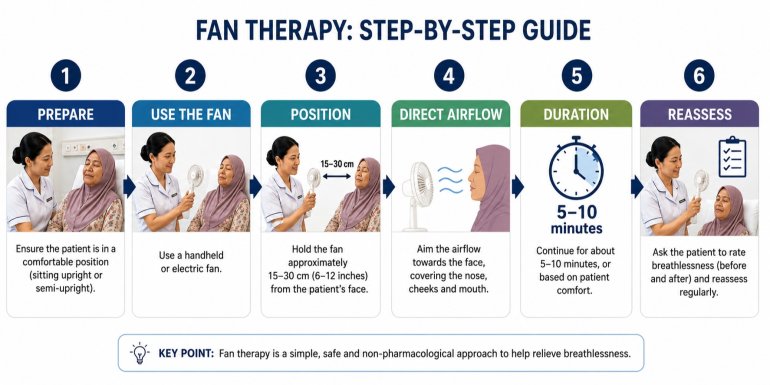
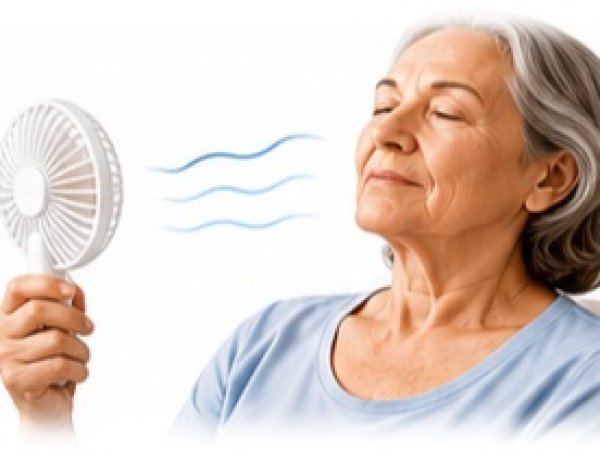
Fan therapy means directing a gentle stream of air from a small handheld or table fan onto the patient's face. It is equally important to be clear about what fan therapy is not. It does not treat the disease-causing breathlessness, and it does not replace proper clinical assessment or appropriate medical treatment. It is best understood as one supportive tool within a wider plan of care.
Figure 1. Correct fan positioning: airflow directed at the cheeks, nose and mouth.
How Does Fan Therapy Work?
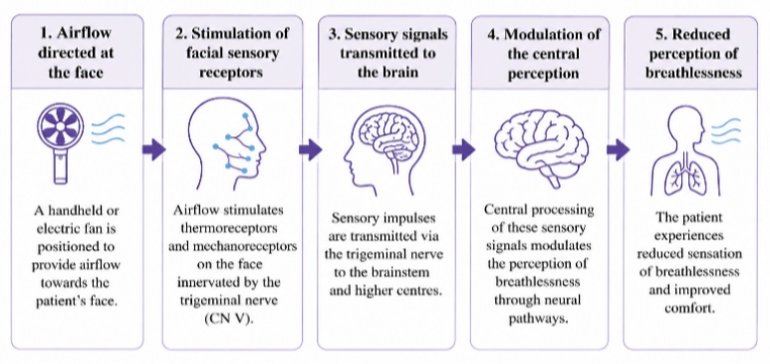
The exact mechanism is not fully understood, but the leading explanation is sensory rather than physiological. Airflow directed at the face is thought to stimulate cutaneous sensory receptors within the distribution of the trigeminal nerve. These sensory signals travel to the brain, where they appear to modulate the central perception of breathlessness.
Figure 2. Proposed mechanism the main effect is on the perception of breathlessness.
In simple terms, the fan does not change how well the lungs are working it changes how breathlessness feels. Benefit is generally seen in the patient's reported sense of breathlessness, not necessarily in objective measures such as oxygen saturation or respiratory rate.
What Does the Evidence Say?
Research on fan therapy spans more than a decade. In a randomized, controlled, crossover trial, Galbraith et al. (2010) found that a handheld fan directed at the face reduced breathlessness intensity compared with airflow directed at the leg. Kako et al. (2018), in a parallel-arm randomized controlled trial in patients with terminal cancer, reported a reduction in breathlessness with fan therapy compared with usual care.
The ASCO guideline on dyspnea in advanced cancer (Hui et al., 2021) supports fan therapy as a reasonable non-pharmacological option, citing its low cost and minimal risk of harm, while noting that overall certainty of evidence remains limited.
A 2026 systematic review by Bausewein et al., published in ERJ Open Research, examined 10 studies (413 participants) with serious respiratory illness, including COPD, interstitial lung disease, bronchiectasis and asthma. It found a possible benefit for immediate, acute relief of breathlessness, but no consistent benefit with long-term daily fan use, and quality of life was rarely reported.
Newer studies add further support: Yue et al. (2024) reported benefit from handheld fans in patients with breathlessness due to respiratory failure, and Topcu et al. (2024) reported improved dyspnoea with fan therapy among hospitalised patients. A 2023 scoping review (Sato et al.) concluded that fan therapy is feasible and generally well tolerated across clinical settings, though technique and duration vary between studies. Current evidence cautiously supports fan therapy as a safe adjunct for the immediate relief of breathlessness, while highlighting the need for further research into its longer-term benefit.
Who May Benefit?
Fan Therapy as Part of Holistic Management
Fan therapy works best as one part of a broader plan of care, not as a stand-alone treatment. It is complementary and should never substitute for appropriate clinical assessment and management of the underlying cause of breathlessness.
How To Implement Fan Therapy
Additional Benefits of Fan Therapy
Fan therapy is a simple, low-cost, non-invasive and portable intervention that may provide rapid relief of breathlessness. It supports patient self-management by allowing patients to control the airflow according to their comfort. A handheld fan can be used across different care settings, including hospital, hospice and home after discharge, and can be carried during outdoor activities or travel. Family caregivers can also assist patients who are unable to use the fan independently.
Fan Therapy Is Not Oxygen Therapy
Directs gentle airflow to the face to help reduce the feeling of breathlessness. Provides extra oxygen to help increase low oxygen levels in the blood.
Helps the person feel less breathless, but does not increase blood oxygen levels. Used when clinically indicated, especially when a person has low blood oxygen levels (hypoxaemia).
A simple, low-cost and non-drug method that can be used as an additional comfort measure. Requires clinical assessment, appropriate prescription and monitoring by healthcare professionals. Adapted from Sato et al. (2023) and Yue et al. (2024).
“Feeling breathless does not automatically mean that the patient needs more oxygen.”
Safety And Practical Considerations
TAKE-HOME MESSAGE
HEALTH EDUCATION CORNER
A. FOR HEALTHCARE COLLEAGUES
“Simple interventions can still be meaningful interventions.”
B. FOR PATIENTS & FAMILIES
“The fan may help you feel more comfortable, but it does not replace medical treatment when treatment is needed.”
C. FOR THE COMMUNITY
KNOW IT. TEACH IT. USE IT APPROPRIATELY. ADVOCATE FOR COMFORT.
“In palliative care, even a gentle flow of air can become part of compassionate care.”
EXPLORE THE EVIDENCE
Scan to access selected peer-reviewed evidence on fan therapy for breathlessness.
Systematic reviews • Clinical guideline • Randomized controlled trials • Safety & feasibility evidence
SCAN • READ • APPLY EVIDENCE-INFORMED CARE