
Dari Ekstrak Ke Isyarat Sel: Menyingkap Potensi Mikroalga Dalam Penyelidikan Kanser
Oct 20, 2026


ANIMAL RESEARCH CENTRE, October 2 2025
Recycling in Wet Labs: Turning Research Waste into Sustainable Action
The Wet Lab Recycling Initiative at the Advanced Medical and Dental Institute (AMDI), Universiti Sains Malaysia (USM), began as a small awareness effort led by Assoc. Prof. Dr. Tan Mei Lan during her time at AMDI. It is now continued and coordinated by Dr. Siti Hawa Binti Ngalim, growing into a structured, community-based effort to reduce laboratory plastic waste and promote responsible research practices.
This initiative reflects AMDI’s strong commitment to sustainability and supports USM’s mission to integrate environmental awareness into education, research, and daily operations.
Building Awareness and Good Habits
The initiative was reintroduced through “Recycling in Wet Labs: A Quick Guide & Tour” on 18 December 2024 at the ARC Seminar Room (Animal Research Complex, AMDI). Participants learned how to identify recyclable plastics such as PET, HDPE, and LDPE, and practiced safe cleaning using Decon90. The session ended with a short tour of AMDI’s recycling area, helping staff and students see how small changes in daily habits can make a big difference for the environment.
Wet lab waste refers to the plastics and containers used in biomedical experiments, including pipette tips, Falcon tubes, reagent bottles, and T-flasks, which often come into contact with liquids, media, or biological samples.
That introductory session laid the groundwork for a year of collective action, turning early awareness into hands-on practice.
From Awareness to Action: A Growing Community Effort
The first Wet Lab Recycling activity in March 2025 gathered students and staff at Taman Herba (Herb Garden), opposite the ARC Seminar Room, to clean, dry, and sort used lab plastics such as pipette tip boxes, reagent bottles, and T-75 flasks.
The second session, held on 19 May 2025, brought together volunteers Zakri Husni bin Abdullah, Nur Alia Afifah binti Zakaria, Lhoshiny Parmeswaran, Rajeswary Sannugawil, Muhammad Arifuddin bin Abd Hamid, and Thurgashini Ravichandran.
For the first time, the team weighed and recorded the total amount of recycled plastics, creating a baseline for AMDI’s sustainability records.
The last session of the year, held on 2 October 2025, brought together volunteers Nur Fitrah Abdullah Sani, Lhoshiny Parmeswaran, Zakri Husni bin Abdullah, Khor Kang Zi, and Wan Amirul Syazwan Wan Ahmad Munawar, who gathered at Taman Herba (Herb Garden) before moving to the CRL 1 Recycling Room for sorting, cleaning, and weighing.
After starting with nearly an hour of sorting and cleaning in the early sessions, the team has now streamlined the process to just about 30 minutes.
Once the recycling was done, everyone gathered for a cheerful lunch at the Herb Garden — complete with local favorites, cold drinks, and laughter. The relaxed meal turned into a small celebration of teamwork and shared commitment, giving volunteers a chance to connect, exchange ideas, and reflect on how far the initiative has come.
Since data collection began, the amount of recycled plastics has grown, from 1.705 kg in the May activity to 3.395 kg in the October activity.
The team also worked more efficiently, having developed a clearer workflow and better coordination through experience. These consistent efforts show how small, collective actions can evolve into a steady culture of sustainability.
How the Recycling is Done
Behind each recycling session is a structured process that ensures biosafety and accountability. Each wet lab recycling cycle takes two days:
All data from AMDI’s green activities, including wet lab waste recycling, CO? emission tracking, and reduction of single-use plastics, are recorded through the AMDI Eco Sustain (ESS) platform at https://ess.amdi.usm.my/ . This centralized system ensures that every contribution supports AMDI’s long-term sustainability goals.
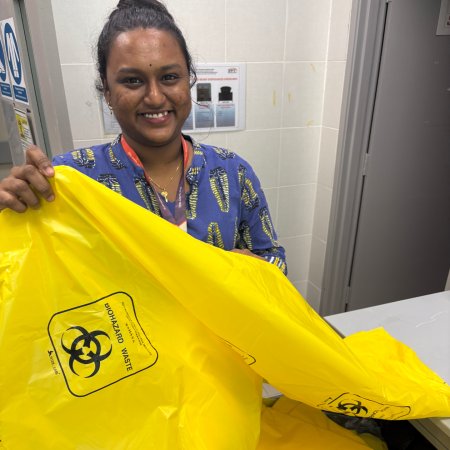
At present, AMDI’s wet lab recycling activities are still carried out mainly through volunteer sessions. To strengthen daily waste management, small pails will soon be placed in the CRL 1 cleaning room to support routine cleaning and sorting. Meanwhile, the science officers have been assisting by providing separate biohazard bins to ensure proper segregation:
This interim system helps maintain biosafety while gradually moving AMDI toward more consistent, lab-level recycling practices that everyone can participate in.
The ongoing message remains clear: “Rinse, sort, recycle yourself — every tube counts.”
Balancing Science and Sustainability
Scientific research plays a vital role in advancing human health, yet it also generates significant waste. In wet labs, this challenge is even more complex because the plastics used may come into contact with chemicals or biological materials.
Instead of treating all items as hazardous waste, the Wet Lab Recycling Initiative encourages safe and effective cleaning and neutralization so that more plastics can be reused or recycled. Many of these materials are made from high-quality, recyclable polymers that can be safely recovered if handled correctly.
By combining biosafety with sustainability, AMDI demonstrates that scientific progress and environmental responsibility can coexist within the same workspace.
Part of a Larger Vision
The lessons learned from this initiative echo USM’s broader environmental mission.
In the Times Higher Education Impact Rankings 2025, USM was recognized among the top universities worldwide for its strong performance in sustainability-driven goals. AMDI’s Wet Lab Recycling Initiative contributes to this vision by showing how focused local actions support global environmental commitments.
This effort also aligns with the broader AMDI Sustainability Program, led by Assoc. Prof. Dr. Khairiah Abd Karim and Dr. Ying Chee Keat, which unites environmental, social, and research-based sustainability projects under one institutional framework.
Looking Ahead
From its beginnings under Assoc. Prof. Dr. Tan Mei Lan to its current coordination by Dr. Siti Hawa Binti Ngalim, the Wet Lab Recycling Initiative continues to evolve.
Through teamwork, better facilities, and consistent awareness, AMDI shows that environmental change begins with small actions at the lab bench.
By reducing single-use plastics and promoting responsible waste management, the initiative supports SDG 12 (Responsible Consumption and Production) and SDG 13 (Climate Action), reinforcing AMDI’s commitment to a sustainable research future.