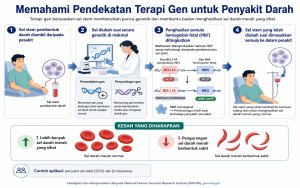
Terapi Gen Untuk Penyakit Darah: Daripada Rawatan Sepanjang Hayat Kepada Potensi Penyembuhan
Aug 14, 2026

May 26 2026
ABO Blood Type and Potential Link to Dementia Risk
Dementia is not a single disease but a clinical syndrome resulting from various underlying conditions that lead to progressive cognitive decline. Among its different types, Alzheimer’s disease is the most common form, accounting for approximately 60% of cases and is associated with the accumulation of beta-amyloid and tau protein in the brain. In contrast, vascular dementia, which is responsible for at least 20% of cases, arises from reduced blood flow to the brain, often due to stroke or damage to small blood vessels (1). Other types of dementia include dementia with Lewy bodies and frontotemporal dementia. Although these forms of dementia differ in their underlying mechanisms, many share common features, such as chronic reduced blood flow to the brain, causing nerve cell damage and brain inflammation, which ultimately leads to a gradual cognitive decline.
ABO blood type and dementia risk
Previous scientific studies have come up with conflicting results on ABO blood type and dementia risk. The largest study to date, which tracked roughly 1.6 million healthy Scandinavian blood donors over several decades, found no link between ABO blood types and Alzheimer’s disease, vascular dementia, or any other form of cognitive decline (2). However, other large studies suggest that the risks might be hidden in specific genetic details, sex differences, or blood type combinations. For example, a large UK study involving nearly half a million adults found that men with the "BB" genotype (inheriting the B blood type from both parents) had a significantly higher risk of dementia (3). Meanwhile, a US study found that people with AB blood type had an 82% higher chance of developing cognitive impairment (4).
Possible Biological Mechanisms of ABO Blood Type and Dementia
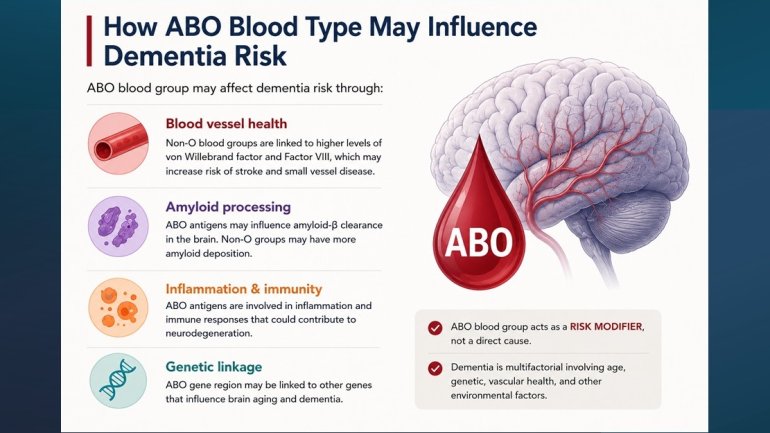
Beyond transfusion medicine, ABO type influences other traits: for example, non-O individuals tend to have higher von Willebrand factor (vWF) and factor VIII levels, which increases the tendency for blood clot formation and can contribute to thrombosis and other vascular complications. As a result, non-O blood groups, particularly AB group, have been associated with a higher risk of cardiovascular diseases, including cognitive decline (4). It has been proposed that elevated coagulation factors in this group may contribute to impaired brain circulation.
In addition to ABO's role in blood clotting, researchers have found that certain genetic markers associated with the ABO blood group are linked to specific molecules that regulate inflammation, including brain inflammation. For example, BB genotype individuals had lower expression of a neurotrophic receptor (GDNF receptor alpha-3), whose function is associated with nerve repair and improved treatments for neurodegenerative diseases (5). While a direct, definitive link between specific blood type and these brain protein changes has not yet been proven, these biological connections offer fascinating new clues into how genetics might shape long-term brain health.
Besides ABO blood type, continuous reductions of blood flow deprive brain cells of oxygen and induce cellular stress, ultimately damaging the vital pathways required for brain cell communication. Moreover, persistent or dysregulated inflammation in the brain can shift from protective to destructive, involving elevated levels of inflammatory proteins (cytokines). Over time, this progressive nerve damage contributes to cognitive decline and the development of neurodegenerative diseases (6). Although these mechanisms are biologically possible, further research is needed to confirm their contribution to the development of dementia.
Clinical and Public Health Implications
At present, ABO blood type is not a clinical factor in dementia risk prediction. Blood type itself cannot be changed, but it may serve as a marker of dementia susceptibility, particularly vascular dementia. For example, knowing a patient is non-O could reinforce attention to vascular risk factor control, given their higher baseline vWF and clot risk. Therefore, patients with type AB or BB blood might be counselled about lifestyle and cardiovascular management to reduce any excess risk. In general, public health messages remain unchanged: maintain healthy blood pressure, lipid, and glucose levels, as vascular health strongly influences dementia risk across all blood types.
References
1. Kalaria RN, Maestre GE, Arizaga R, Friedland RP, Galasko D, Hall K, Luchsinger JA, Ogunniyi A, Perry EK, Potocnik F, Prince M. Alzheimer's disease and vascular dementia in developing countries: prevalence, management, and risk factors. The Lancet Neurology. 2008;7(9):812-26.
2. Vasan SK, Rostgaard K, Ullum H, Melbye M, Hjalgrim H, Edgren G. ABO blood group and dementia risk–a Scandinavian record-linkage study. PloS one. 2015;10(6):e0129115.
3. Li M, Yu R, Wang X, Zhao Y, Song Q, Wang Q, Fu C, Mishra SR, Shrestha N, Virani SS, Zhu D. Association between ABO genotypes and risk of dementia and neuroimaging markers: roles of sex and APOE status. Frontiers in Neurology. 2024;15:1391010.
4. Alexander KS, Zakai NA, Gillett S, McClure LA, Wadley V, Unverzagt F, Cushman M. ABO blood type, factor VIII, and incident cognitive impairment in the REGARDS cohort. Neurology. 2014;83(14):1271-6.
5. Cintrón-Colón AF, Almeida-Alves G, Boynton AM, Spitsbergen JM. GDNF synthesis, signaling, and retrograde transport in motor neurons. Cell Tissue Res. 2020;382(1):47-56.
6. Iadecola C. The pathobiology of vascular dementia. Neuron. 2013;80(4):844-66